
| Bth | 10/12/85 | Great Lever | Lancashire |
| P/H/W | Centre-Forward | 5ft 8in | 12st 7-12lb |
| Jnd | 26/11/08 (22) | Bolton | £1,650 |
| Deb | 05/12/08 (22) | Sunderland (H) | Div 1 |
| Dep | 10/07/14 (28) | Bradford City | £1,750 |
| A/G | 123 | 92 |
| Season | App | Gls | Posn |
| 1908/09 | 21 | 15 | 9 |
| 1909/10 | 36 | 31 | 9 |
| 1910/11 | 38 | 33 | 9 |
| 1911/12 | |||
| 1912/13 | 08 | 03 | 9 |
| 1913/14 | 20 | 10 | 9 |
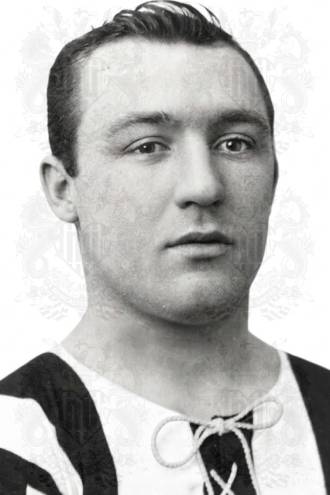
England international Albert Shepherd arrived on Tyneside for a record fee after he had scored 85 goals in 115 appearances for Bolton. The well-built centre-forward consolidated United’s attack into a powerful and dangerous firing line and, to many observers at the time, he would become perhaps the greatest match-winning forward of the day.
The fee was not made public, and although Albert said he didn’t know what it was, he knew it was a record. One Liverpool correspondent said £1,650.
Shepherd was a pivot whose powers of combination were limited, but was a strong, bustling centre with immense personal strength. Sturdiness personified in build; thick-set, pure bone and muscle and with a neck like a wrestling champion.
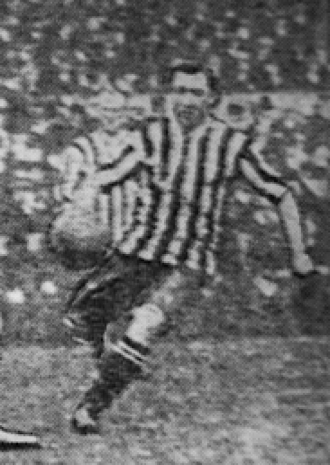
Shepherd was keen on dashing between the backs and it was thrilling to see him pounding down on goal with long, purposeful strides, crashing through the opponents' defence at unexpected moments.
Albert was not just about strength though. He was an expert dribbler and considering his build, his nimbleness was wonderful.
A thrustful forward who had a great eye for the "main chance" and a crack shot with a great goal scoring record.
Shepherd was top scorer in his first four seasons at the club his overall strike rate was 75% which makes him the third most prolific striker (of players making 20 or more appearances) in the club’s history behind Hughie Gallacher and Andy Cole.
In his first full season on Tyneside he scored 31 goals in 36 games in 1909/10, beating Jock Peddie’s previous United record haul of 20 goals by some margin. And Albert surpassed his own record in the following season, notching 33 in 38 games and finished as the top scorer in Division 1.
In January 1909 Shepherd scored four goals in United’s 4-0 victory over Notts County at Trent Bridge. After his fourth he left the pitch for a reason unknown at the time. Colin Veitch would later reveal that Albert had obtained a weekend leave to go home to Bolton, and as it was an early kick-off, a convenient train left Nottingham just after the match was timed to finish. He asked for permission to leave the field ten minutes before the finish of the game, if matters were going favourably for the team. Jocularly, he was informed that he could, if he scored four goals. And after registering a blank before the break he duly achieved the set target with seven minutes left.
In 1910 Shepherd helped the Magpies win the FA Cup for the first time. scoring both goals against Barnsley in the replay, including the first penalty goal in a Cup Final.
However he almost did not get to play in the game due to highly controversial circumstances. The day before the semi-final against Swindon at Tottenham, United had a League fixture to fulfill against Woolwich.
Not surprisingly the club fielded a complete reserve team with one extraordinary exception; Shepherd at centre-forward. It was a poor game and Albert was very erratic. He missed so many chances that he was mildly barracked by some of the crowd for a couple of minutes.
Nine minutes from time Shepherd walked off the field. The referee, Mr Pellowe, called Shepherd back and asked him why he had retired without permission. He informed the official that it was a protest against the hissing of the crowd.
Mr Pellowe informed Shepherd that he had no right to ignore him and intimated that he would report the matter to the League authorities; (he would be fined £5).
Albert immediately got a train to London, but he was not selected for the semi-final.
It became apparent to the players that the reason for his shock admission was that the Directorate had taken heed of rumours that he had been “got at” by bookies and would therefore have been a “non trier”.
Colin Veitch revealed that the players were incensed and demanded that he was reinstated for the Final. And conceded that if that had not been the case “there was a great chance that some other players would be “diplomatic” absentees.
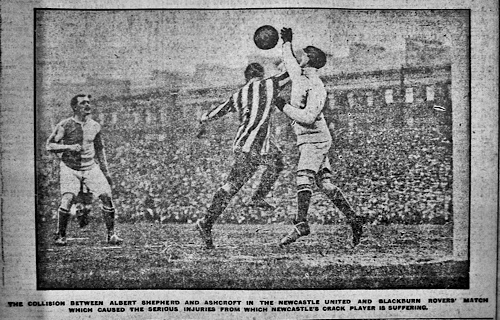
Just before the 1911 Cup Final Albert suffered a very bad injury against Blackburn Rovers. He was rushing for goal at top speed when he came into a violent collision with Ashcroft, the Rovers' goalkeeper. He fell heavily, and his groans quickly indicated that he had been badly hurt.
He had badly stretched and torn the ligaments behind his right knee and was out of action for n months. Although he returned and continued to score, he was never quite the same player again.
Albert played for England against Scotland in 1906 (before he joined the Magpies) and he won a second cap against Ireland in 1911. And he once scored four for the English League against the Scottish League.
The portrait (which is not verified) is a digital design which will assist in painting the player as part of the nufc collection ‘Men in Stripes’ and is copyright Piotr Jozefowicz.
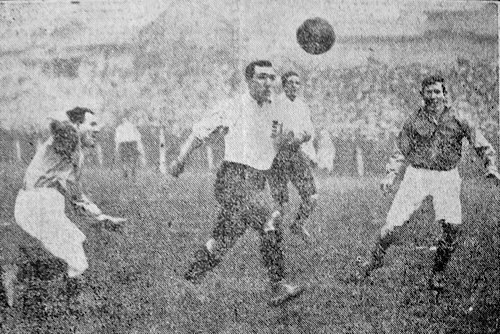
Match photos are from original newspapers at the Newcastle Library Local Studies department.
For a more extensive biography of his full career see the Paul Joannou book "Newcastle United - The Ultimate Who's Who 1881-2014" and the accompanying supplement "The Ultimate Who's Who Supplement 1"