

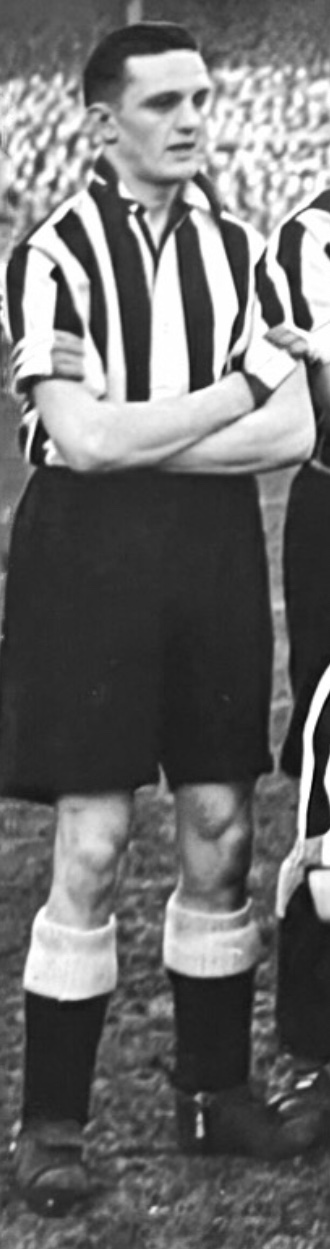
| Bth | 15/02/26 | Preston | |
| P/H/W | Wing-Half | 5ft 9.5in | |
| Jnd | 24/01/48 (21) | Ballymena | £5,500 |
| Deb | 31/01/48 (21) | Leicester | Div 1 |
| Dep | 07/53 (27) | Released | |
| A/G | 57 | 10 |
Although Frank Houghton was signed as a wing-half, his adaptability resulted in him being used as a utility man. His career on Tyneside got off to a great start, but injury and illness would limit his appearances and eventually end his career.
Frank was born in Preston and was an amateur on his home town club’s books before he moved to Ireland.
He was signed after the Cup tie between Ballymena and Linfield; there were a number of clubs interested in securing his services, but United had the finances and moved swiftly.
Houghton was a player of rare enthusiasm, courage and opportunism. He was always full of pep and energy and got through a prodigious amount of work. However his wholehearted endeavour would occasionally lead to injudicious wandering which left gaps in defence.
As with many players who could play in a variety of positions he struggled to keep a regular place in the side. But whenever or wherever he featured, he always played to the absolute limit of his ability.
He gave his best service as an attacking wing-half, appearing as a “4” and “6”. But he also turned out at outside-right, inside-right, centre-forward and inside-left. He even went in goal when Fairbrother was injured against Liverpool in the 1949/50 season.
He will always be best remembered for his two goals in the last five minutes against Sheffield Wednesday in April 1948 which virtually ensured promotion for United. He broke his arm and gashed his leg in the process of scoring the second and had to be carried off. Suffering from severe shock, he did not know what he had done until he was informed in the dressing room.
He was very popular in Ireland and when the Magpies went on a tour there at the end of the 1947/48 season and played at Ballymena, the biggest cheer of the day was for Frank who kicked off at the start of the game.
He submitted a transfer request during the 1949/50 season which was rejected. At the start of 1950/51 he once more asked for a move citing domestic reasons; he wanted to return to Ireland.
Although a number of clubs were interested the £18,000 asking fee was a significant obstacle. Second Division Manchester City provided United with an acceptable offer, but Frank turned down the move.
It was initially thought it was because he wanted to stay in the First Division, but Frank clarified that he did not want to go to Manchester because of comments published in a Sunday newspaper by their chairman, Mr. Smith.
He had made a number of controversial allegations about the world of football. These included adverse criticisms regarding footballers including allegations of "under the counter" payments.
Houghton added that he could not join a club that had such a stringent code of conduct for players. Rules included a ban on motorcycling, players were forbidden to attend dances after Wednesday, a limit on smoking and a ban on the visit of friends into the dressing-room without permission on match or training days.
A few weeks later Frank was hospitalised with pneumonia which led to tuberculosis and pleurisy. His weight plummeted to eight stones and Doctors said he would not be able to play again.
Over the next two years the club sent him to Davos in Switzerland for long spells of recuperation and treatment in an attempt to save his career.
The situation looked promising when he returned to training in the 1952/53 season whilst looking after the fourth team. But a scheduled return to Switzerland for a final check-up was followed, in February 1953, by a major operation in Nunthorpe near Middlesbrough.
It had become clear that he would, after all, not be able to play again and he was given a free-transfer in July 1953. The club had already provided him with new accommodation and offered to set him up with a shop.
But he wanted to stay in football and former teammate Norman Dodgin, who was now player-manager at Exeter City, gave him an assistant trainer role.
On the face of it the club had paid for the best treatment and care possible for thirty months. However, there is little doubt that the quality of accommodation he had initially been provided with almost certainly played a significant part in causing his ill health.
Joe Harvey and Len Shackleton had previously gone on strike over their accommodation and Roy Bentley had left after suffering illness, which he also partially attributed to the condition of the house he was provided with. All of this at a time when the club’s income was incredibly high due to the post-war boom in attendances.

Made his debut in the home win over Leicester in January, a couple of weeks after he had been signed from Ballymena for £6,000. Playing as an emergency right-winger, he scored the two late goals in the top of the table clash with Sheffield Wednesday which virtually clinched promotion.
With Dodgin playing so well Houghton rarely featured. In December suffered a shin injury which required hospital treatment. He went on the summer tour of North America.
Played in five different positions during the season and even took over in goal when Fairbrother was injured in the home match against Liverpool. He submitted a transfer request in February, but the Board refused to accede and, with Milburn injured, he was given a run in the side at centre-forward which proved surprisingly successful.
He played in the first three games of the season before being replaced by Crowe. His final game for the club was at centre-forward in the 3-0 defeat at Aston Villa in October.
Painting by Piotr Jozefowicz - if you would like a copy of this painting or a copy of the painting of any other player, past or present, please contact Piotr directly at: 008bond@wp.pl